
Chapter 17 Common Types of Attacks
2. Technology Based Attacks
2.7. Malware & Viruses
Audio
Transcript
Let's talk a little bit about malware and viruses.
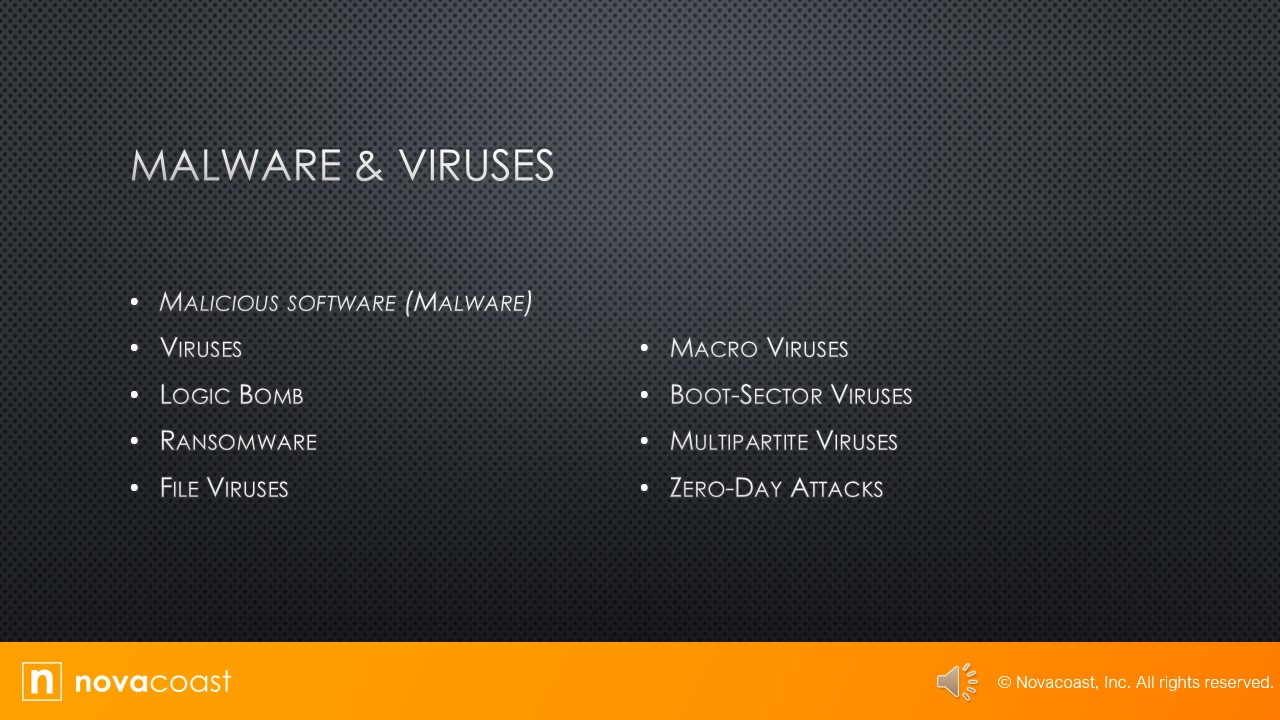
So, malware is malicious software.
It is a term that describes any software that harms the computer, deletes data or takes action the user did not authorize.
A worm is a type of malware that can spread without the assistance of the user.
A worm is a small program like a virus and is used to deliver a payload.
One way to help mitigate the efforts of a worm is to place limits on sharing, writing, and executing programs.
However, the real solution is to deploy antivirus anti malware software which is intrusion protection.
So then viruses:
Viruses have, there's been a lot of popular ones out there, like the love bug.
They are the best-known threats to your computer security because they get a lot of media coverage as they proliferate and cause tons of damage to lots of people.
In simpler forms, Viruses are basically little programs that cause a variety of very bad things to happen to your computer, ranging from merely annoying to totally devastating.
They can display a message, delete files, or even send huge amounts of meaningless data over a net, they can wipe your hard drive completely.
That's viruses.
So, the next thing is a logic bomb.
A logic bomb is the type of malware that is executed when a particular event takes place.
For example, the event could be a time or a date specified.
So that's the virus that kicks off when a time or date or when a program is used like say, Notepad or something like that.
Ransomware we've talked about, where they take over your computer and encrypt it, and you are paying to get your information back, and most time they'll give it back because they don't want to get a bad name for not giving it back, because they want people to pay up.
A fire file virus attacks executable applications and system program files like those that.
And then .com, .exe, and .dll, which mostly are commands.
These viruses do damage by replacing some or all of the target program code with their own.
And then boot sector viruses:
Boot sector viruses work their way into the master boot record that essentially will Ground Zero sector on your hard disk, so your hard disk has a boot sector when it tells you how to boot.
And these viruses will go in and destroy that.
Then Multipartite viruses:
A multipartite virus is one that affects both the boot sector and the files on your computer and is particularly dangerous and difficult to remove.
And then we've talked about zero-day attacks, basically those are attacks that have never been seen before.
Not always a virus could be other attack methods, but zero day generally means it's the first time it's been seen.
There is no way to mitigate it at that point, at that time, if you have virus protection.
They a lot of times won't catch 0 day, but hopefully they update quickly before you get it and can protect you that way.