
Chapter 20 Physical Security
1. Physical Security
1.1. Detection Methods
Audio
Transcript
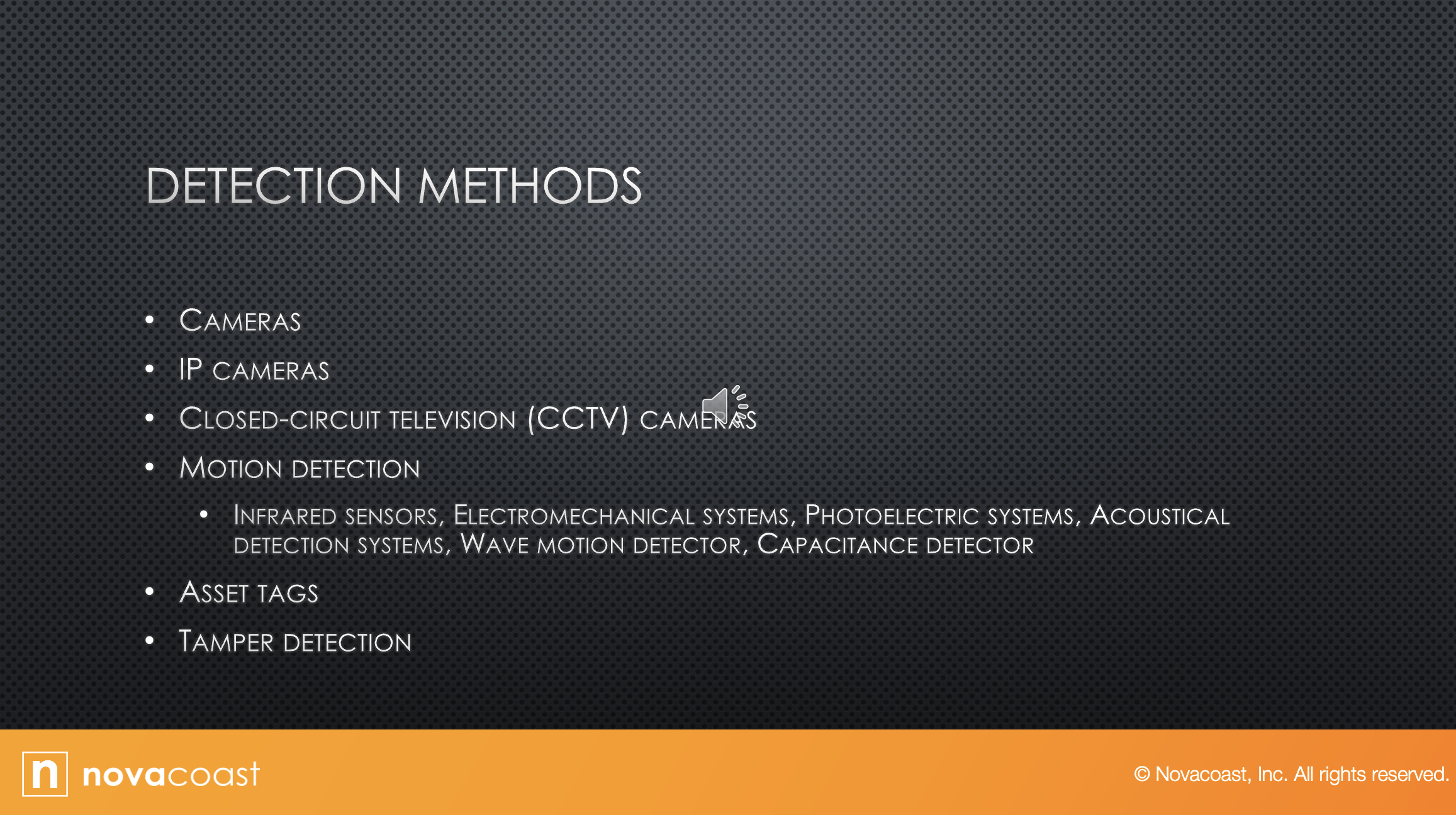
So, let's talk about detection methods.
Cameras:
You want cameras in any high security scenarios that are can be visually monitoring the area 24 hours a day.
It makes sense to deploy video monitoring as well.
So, if you have cameras up, you might as well have somebody monitoring that.
And then you can use IP cameras, which are cameras that use an IP address.
They can send the signal out digitally throughout the facility.
Or you can use CCTV cameras which are closed circuit cameras.
That image does not come through an IP address but will go directly to the monitor or to whatever system is there capturing that.
It can be converted to be used into an IP system, but that's not how it transmits.
Then motion detection.
Ways for motion detection:
Infrared sensors identify changes in heat waves in the area and the presence of an intruders would raise the temperature of the surrounding area.
Electromechanical systems operate by detecting a break in an electrical circuit.
So, think of a door that has a sensor on the door and a sensor on the frame, and when you open that door up, it breaks that connection.
That is electrical.
An electromechanical system:
Security tape on a window, or the same type of sensors on the window.
Photo electric systems operate by detecting changes in the light and thus are used in windowless areas.
Sends a beam of light across the area, and if the beam is interrupted, the alarm is triggered.
Acoustical detection system is sound, so it listens for sounds.
You need it in a quiet area.
A lot of times server rooms aren't quiet, whether it be the air conditioning or the servers themselves.
You need that in a quiet area.
Maybe a switch room that doesn't have a server in it, something like that.
Wave motion detection:
These devices generate a wave pattern in the area and detect any motion that disturbs that wave pattern.
And then capacitance detection:
This device emits a magnetic field.
So, whenever somebody walks in, it changes that magnetic field.
It breaks that.
So that is capacitance detection.
Then you can also use asset tags.
Basically, that's any kind of label that you put on a device that say what it is, serial number, however, you're assigning that.
Maybe you have records that have a number from the computer, and then you have the serial number and all that.
So, you put a tag on the computer, it says, “Property of David Mayne,” and at this is computer 1234, acquired on this date, et cetera, whatever information you want to tag.
But it can be as little as a sticky strip that sticks to it and tags it.
And then tamper detection.
That is something that you can set up in the BIOS for the UEFI on the motherboard and that basically will let you know if somebody has tampered with the chassis, the case.
If they've tried to open it, or if they if they've taken the lid off of the box to go in and tamper with the computer.